ThinkFun
ThinkFun Circuit Maze – Introductory Electrical Engineering Logic Game
ThinkFun Circuit Maze – Introductory Electrical Engineering Logic Game
Free Curriculum & Lesson PlansOpen your printable three-session learning guide
DiscoveryBin | Where Every Day Is a New Discovery
Curriculum & Learning Guide
ThinkFun Circuit Maze – Introductory Electrical Engineering Logic Game
Subject: Career & Trade Skills • Grade levels: 4th–6th Grade, 7th–9th Grade, 10th–12th Grade • Recommended ages: Ages 8+ (manufacturer recommendation)
Learning objective: Use logic and basic circuit concepts to solve design challenges.
How to teach this unit
Suggested time: 10-20 minutes per session, shortened as needed. Prepare the product, a comfortable safe space, and optional visual cues or a parent observation log.
Learning outcomes: The student will learn the target skill, practice it with feedback, use it in a final activity, and show or explain one thing learned. Adjust pacing without changing the goal.
Three-session lesson plan
Session 1 - Explore and model
- Introduce the learning objective. Demonstrate safe use and explain what the student will practice.
- Learn the game's component rules and identify a complete path.
- Ask what the learner noticed and save a quick baseline observation or first work sample.
Session 2 - Guided practice
- Review one important skill or observation from Session 1.
- Build an introductory circuit challenge and test the result.
- Offer a specific correction or strategy, repeat once, and compare what changed.
Session 3 - Apply and explain
- Invite the learner to predict an outcome or set a reasonable goal.
- Solve a harder challenge by changing one component at a time.
- Discuss what improved, what was difficult, and what the learner would try next. Save evidence of the final task.
Show what was learned
Suggested evidence of learning: Keep a circuit sketch and log at least two test revisions.
- □ Followed instructions and safe handling guidance
- □ Practiced the target skill with suitable help
- □ Applied one suggestion or made an adjustment
- □ Completed a work sample or explained learning
Parent assessment: Compare the learner's first and last attempts or work samples. Look for effort, understanding, better technique, more consistent performance, or a completed creative result. Record the kind of support needed rather than giving a grade based only on speed or score.
Adaptations: Parents may change timing, repetition, reading support, or adult assistance to fit the student. Older learners can add measurements, explanations, or a written reflection.
Safety: Follow manufacturer age/battery guidance; never connect to household electricity.
Parent learning record
Product: ThinkFun Circuit Maze – Introductory Electrical Engineering Logic Game • SKU: DB-TRADE-TF-CIRCUIT
Student: ______________________________ Grade: _____________
Instruction dates: _______________________ Total time: ___________
Learning objective / skill practiced: ______________________________________________
Work sample or observation: ____________________________________________________
__________________________________________________________________________
Improvement noticed / next steps: _______________________________________________
__________________________________________________________________________
Parent or instructor: ___________________________ Date: _______________
DiscoveryBin original supplemental curriculum | 10-14-2026. These learning activities do not guarantee school credit, ESA reimbursement, or approval by a state or scholarship program. Always follow manufacturer age and safety directions.
On a Mac, select PDF > Save as PDF in the print window. The printable version opens separately from the shopping page.
Couldn't load pickup availability
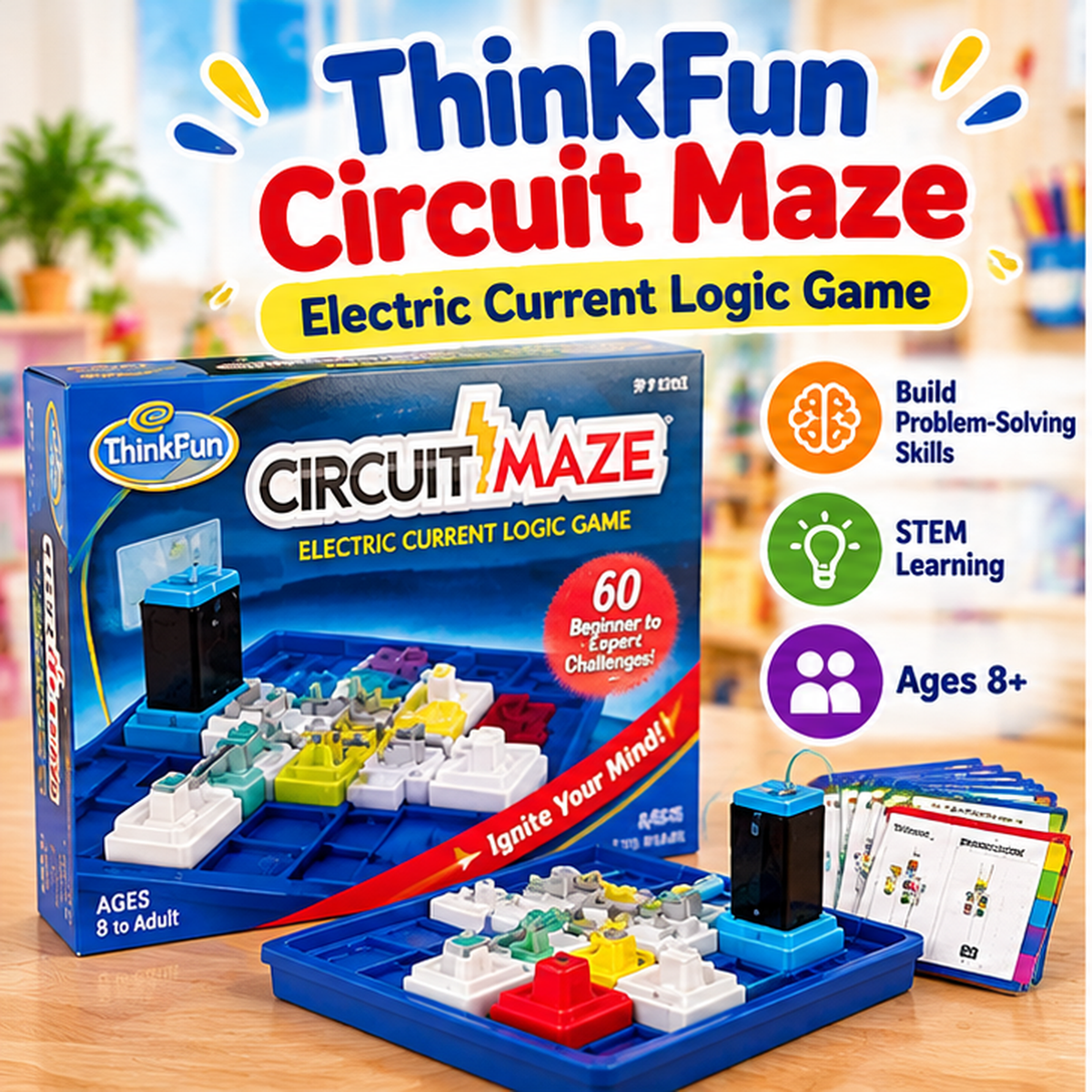
Explore how electrical circuits work, one challenge at a time. ThinkFun Circuit Maze combines a hands-on circuit board with a series of progressively more challenging logic puzzles.
What students practice
- Creating a closed circuit that lights LED beacons.
- Logical reasoning, planning and troubleshooting.
- Understanding the basics of electrical connections and circuit pathways.
- Solving 60 challenges, from beginner to expert.
Manufacturer recommended age: 8 years and up. Designed as a single-player activity. Suitable as an introductory electronics and engineering exploration resource for homeschool students, including older learners new to the subject.
In the box: a game grid, circuit-building pieces, challenge cards and instructions.
Power: Requires three AAA batteries, which are not included according to the manufacturer's instructions. Follow the supplied instructions and safety warnings.
Scholarship and education savings account reimbursement is subject to each program's rules. Product eligibility is not guaranteed.
Share